
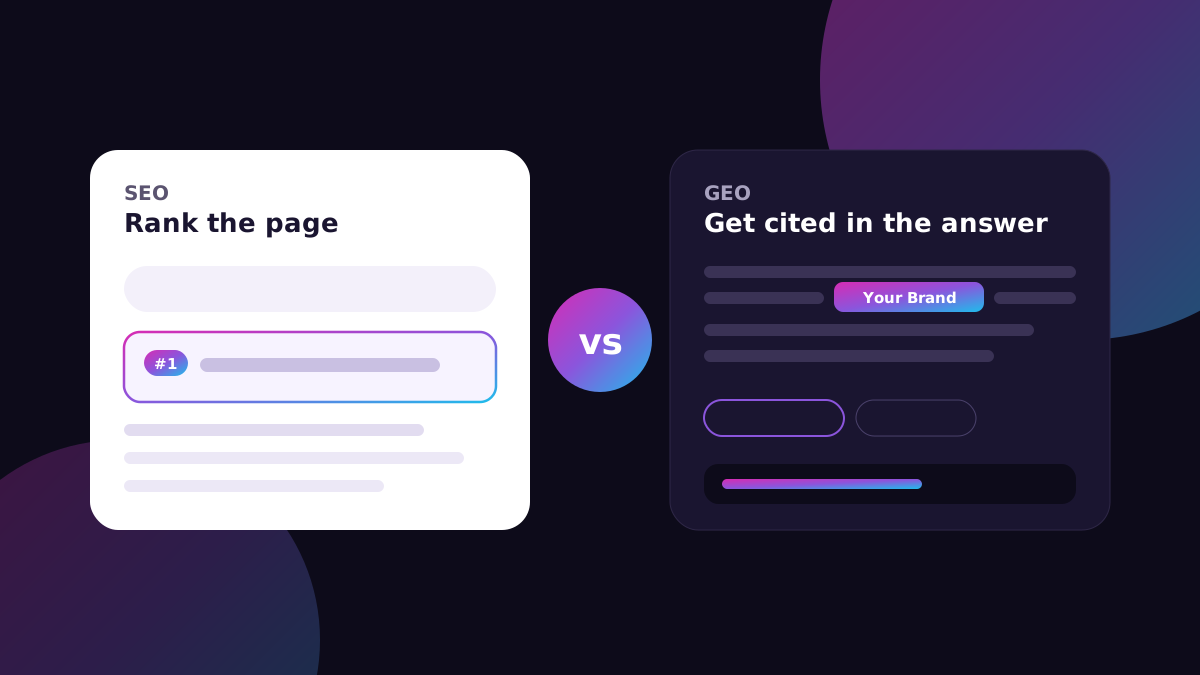
A client asked us last month: "Should we stop doing SEO and switch to GEO?" It is a fair question. Every week there is a new headline saying search is dead and AI chatbots will answer everything. The short answer is no, you should not stop SEO. But you should understand what GEO adds, because the way people find businesses is changing.
What SEO does
Search engine optimization is the work of getting your pages to rank in Google's list of results. It covers technical health (can Google crawl and understand your site?), relevance (does the page match what the person searched?) and authority (do other trusted sites link to you?). When it works, you get clicks from people who are actively looking for what you sell.
What GEO does
Generative engine optimization is the work of getting your brand mentioned and cited inside AI-written answers, in tools like ChatGPT, Google Gemini, Perplexity, Copilot and Google's AI Overviews. Instead of ranking a single page, you are trying to be one of the names the model chooses when it writes a recommendation.
Some people call this answer engine optimization (AEO) or LLM SEO. The labels differ; the goal is the same.
Why GEO suddenly matters
Three pieces of research explain the shift:
- Gartner predicted in 2024 that traditional search engine volume will fall 25% by 2026 because of AI chatbots and virtual agents.
- A Pew Research Center study found that when Google showed an AI summary, people clicked a normal search result on 8% of visits, compared with 15% when there was no summary. Only about 1% clicked a link inside the summary.
- Google has said its AI Overviews reach more than two billion users every month.
Put together, this means more searches end without a click. If an AI answer names three companies and you are not one of them, ranking fifth on the normal results helps far less than it used to.
GEO vs SEO: the key differences
1. Pages vs brands
SEO is mostly about individual pages. GEO is about your brand as a whole. A model forms a view of your business from many places: your site, reviews, directories, news, forums and comparison articles.
2. Rankings vs mentions
In SEO you track positions. In GEO you track how often you are mentioned for a set of real questions, and how you are described. There is no "position one" in a paragraph of text.
3. Keywords vs questions
People type short keywords into Google ("seo agency delhi") but ask AI tools full questions ("which SEO agency in Delhi is good for a small clinic with a tight budget?"). Content that answers specific, detailed questions clearly is more likely to be used.
4. Your site vs the whole web
Links still matter for SEO. For GEO, plain mentions of your brand on trusted sites matter too, even without a link, because they shape what the model "knows" about you.
Where they overlap
Here is the part most hype articles skip: good GEO sits on top of good SEO. AI tools that search the live web often pull from pages that already rank well. Clear structure, fast pages, accurate facts, schema markup and real expertise help with both. So the choice is not GEO or SEO. It is SEO first, then GEO on top.
What to do first
- Check where you stand. Ask ChatGPT, Gemini and Perplexity the five questions your buyers ask most. Note who gets named.
- Fix your basics. Make sure your name, services, locations and contact details are the same everywhere online.
- Rewrite your key pages to answer questions directly. Short definitions, clear prices or price ranges, comparisons and FAQs.
- Earn mentions. Get listed in relevant directories and industry lists, collect genuine reviews, and contribute to articles in your field.
- Track monthly. Re-run the same questions and see what changes.
A quick example
Take a dental clinic in Pune. For SEO, it wants to rank for "dentist in Baner" and "root canal cost Pune". For GEO, it wants ChatGPT to mention it when someone asks "which dental clinics in Baner are good for nervous patients?"
The SEO work is familiar: a fast page for each treatment, a page for Baner, a clean Google Business Profile and reviews. The GEO work adds a few things on top: a clear "about the clinic" section that states how long it has been open and who the dentists are, honest price ranges on treatment pages, answers to the exact worries patients raise, and mentions in local health directories and neighbourhood guides. None of this is a trick. It is simply making the clinic easy to describe accurately.
GEO vs SEO: the bottom line
When people ask us about GEO vs SEO, our answer is the same every time. SEO gets you found when people search. GEO gets you mentioned when people ask. The businesses that will win over the next few years are the ones that do both, in that order.
If you want help with any of this, our AI SEO and GEO services start with a free visibility check, and our SEO services build the foundation it all sits on.
Frequently asked questions
Is GEO replacing SEO?
No. AI tools still find and trust sources largely through the same signals search engines use: crawlable pages, clear answers, authority and mentions on other websites. GEO builds on top of good SEO rather than replacing it.
How do I know if ChatGPT or Google AI Overviews mention my business?
Ask the AI tools the questions your customers ask, in their words and for your city, and note whether you are named or linked. Repeat it monthly with the same questions so you can see the trend.
What is the first step for GEO on a small business website?
Make sure each service has its own page that answers the main questions clearly near the top, with your business name, location and contact details easy to find, and FAQ and LocalBusiness schema added.